
저는 FIBC 벌크백과 폴리프로필렌 직조 포장 분야에서 10년 이상의 실무 경험을 보유하고 있으며, 특히 소재, 제조 공정 및 실제 적용 사례에 중점을 두고 있습니다. 생산 및 물류 팀과 긴밀히 협력하여 일관성, 성능 및 실용성을 개선하고 있으며, 산업용 포장 개념을 더 쉽게 이해할 수 있도록 관련 정보를 공유하는 것을 즐깁니다.


저는 FIBC 벌크백과 폴리프로필렌 직조 포장 분야에서 10년 이상의 실무 경험을 보유하고 있으며, 특히 소재, 제조 공정 및 실제 적용 사례에 중점을 두고 있습니다. 생산 및 물류 팀과 긴밀히 협력하여 일관성, 성능 및 실용성을 개선하고 있으며, 산업용 포장 개념을 더 쉽게 이해할 수 있도록 관련 정보를 공유하는 것을 즐깁니다.
During the complex stages of production, industrial storage, and cross-border transportation of chemical powders, Flexible Intermediate Bulk Containers (FIBCs) represent the most cost-effective and highly efficient bulk packaging framework available to the modern supply chain. However, this specific packaging node is frequently the most misunderstood and overlooked component by procurement teams. Chemical powders fundamentally differ from standard industrial aggregates or agricultural products. They are typically characterized by an incredibly small particle volume, a notoriously high tendency to generate airborne dust, and severe susceptibility to moisture-induced chemical degradation. Furthermore, many fine chemical powders are highly reactive, possessing flammable or explosive characteristics when subjected to dynamic friction. Attempting to package these highly sensitive and volatile materials in conventional, off-the-shelf woven bags is an operational misstep that guarantees failure. A standard bulk bag will routinely leak upon filling and is highly prone to structural fatigue during transit. This systemic packaging failure not only causes substantial high-value raw material loss but also brings about severe environmental contamination, regulatory penalties, and catastrophic safety hazards within the processing plant.
Driven by a misguided attempt to reduce upfront procurement costs, numerous enterprises mistakenly utilize standard, unspecialized bulk bags to package fine chemical powders such as ultra-pure titanium dioxide, conductive carbon black, nano-calcium carbonate, talcum powder, and reactive metal powders. The inevitable result of this mismatch is a series of frequent, predictable, and highly destructive operational failures. The structural integrity and material science of standard FIBCs simply do not align with the microscopic fluid dynamics of ultra-fine particulate matter. They are strictly engineered for granular or blocky materials; upgrading to dedicated, hermetically sealed FIBCs for chemical powders is not merely an operational luxury, but an absolute structural necessity.
The primary symptom of this failure manifests as severe dust leakage. The inherent physical gaps within standard woven polypropylene fabrics, combined with the enlarged needle holes created during the industrial sewing process, provide a frictionless escape route for fine powders. Under the dynamic physical stress, vibration, and stretching of a one-ton payload during forklift maneuvering or ocean freight, these microscopic structural gaps widen significantly. Powders with a particle size finer than 300 mesh will easily escape, heavily polluting the workshop environment and directly endangering the respiratory health of facility employees.
Furthermore, standard bags suffer from severe moisture absorption. Lacking a dedicated vapor sealing mechanism, the packaged raw materials are continuously exposed to ambient humidity fluctuations, leading to moisture-induced degradation that fundamentally alters the chemical reactivity and ruins the final product quality. The most critical threat, however, involves electrostatic discharge (ESD). As dry powder particles aggressively rub against each other and the woven polymer fabric during rapid pneumatic filling and discharging operations, they generate significant electrostatic charges through triboelectric charging. In an ungrounded standard bag, this accumulated high-voltage static electricity is highly prone to triggering catastrophic combustible dust explosions.
| Performance Metric & Operational Risk | Standard Industrial FIBC Packaging | Specialized Chemical Powder FIBC |
|---|---|---|
| Fine Powder Leakage Rate (< 500 mesh) | 3.5% - 5.0% (Continuous facility dusting) | Below 0.05% (Sift-proof mechanics) |
| Moisture Vapor Transmission (MVTR) | > 15 g/(m²·24h) (Rapid product caking) | < 0.1 g/(m²·24h) (With barrier liners) |
| Electrostatic Surface Resistivity | 10¹² - 10¹⁴ Ω (Extreme explosion danger) | < 10⁷ Ω (Safe grounding/dissipation) |

Key Technical Features of FIBC Bulk Bags for Chemical Powders
To safely and effectively manage these complex materials, plant managers and procurement teams must pivot their evaluation criteria from basic weight capacities to advanced material containment technologies. When selecting FIBCs for chemical powders, the evaluation framework rests on three critical focal points.
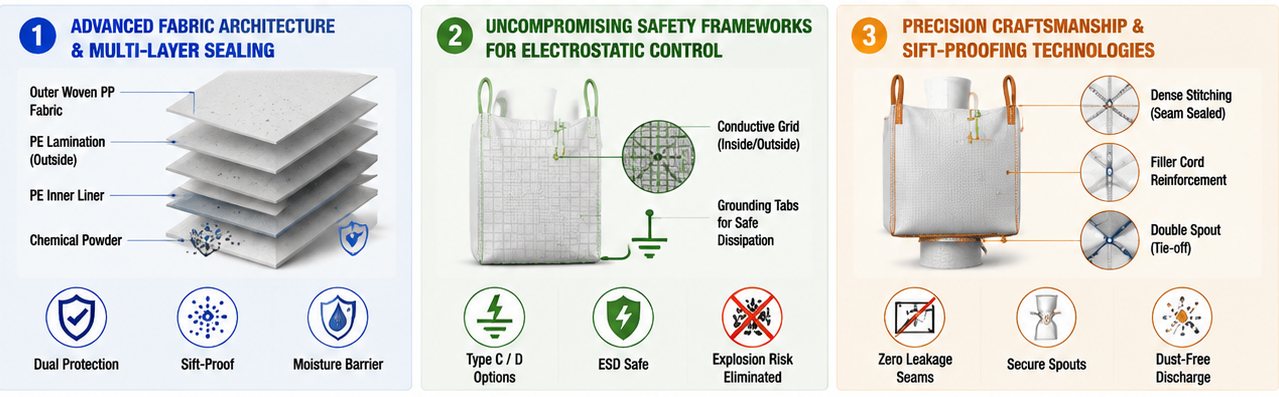
1. Advanced Fabric Architecture and Multi-Layer Sealing: The fabric configuration is paramount; it absolutely must feature a robust combination of lamination and an internal liner, creating a dual-seal system that aggressively prevents powder leakage. When dealing with chemical powders, evaluating fabric based solely on thickness or GSM is a flawed methodology; one must heavily scrutinize its microscopic sealing properties. The universally accepted standard protocol dictates the use of high-density PP (Polypropylene) woven fabric combined with double-sided PE (Polyethylene) lamination, complemented by an internal PE liner bag. The external lamination effectively seals the inherent gaps in the woven fabric, while the internal PE bag achieves complete closed-loop physical isolation. For extremely hygroscopic chemical raw materials or premium pharmaceutical intermediates that have zero tolerance for moisture and oxygen, standard polyethylene is entirely insufficient. In these high-stakes scenarios, facilities must upgrade to a highly specialized Aluminum Foil Laminate FIBC Bag. This multi-layered metallic barrier structure thoroughly isolates the inner material from external water vapor, oxygen transmission, and ultraviolet degradation, ensuring total chemical stability during extended trans-oceanic shipping.
2. Uncompromising Safety Frameworks for Electrostatic Control: For flammable and explosive powder materials, mitigating static buildup is an absolute mandatory safety requirement mandated by global industry standards. Materials such as sulfur, combustible metal powders, and specific synthetic resin additives inherently possess remarkably low Minimum Ignition Energies (MIE). When standard bulk bags generate triboelectric charging through high-velocity friction, the resulting static spark acts as a primary ignition source. To mitigate this severe threat, hazardous materials must strictly utilize a properly engineered Type C Conductive FIBC Bag. This specialized conductive packaging operates by utilizing a highly precise grid of interwoven conductive carbon or silver threads. When the designated grounding tabs are physically connected to the facility's grounding system during filling and discharging, accumulated static electricity is safely and instantly channeled into the earth, lowering the spark risk to absolute zero.
3. Precision Craftsmanship and Sift-Proofing Technologies: Even if the external fabric barrier is technologically flawless, inadequate or hasty manufacturing processes will inevitably lead to severe powder leakage at the structural seams. The specialized craftsmanship required for chemical powder FIBCs demands extremely dense stitch spacing to actively reduce the occurrence of needle hole leakage. Furthermore, highly resilient sealing rubber strips or specialized continuous filler cords must be strategically sewn into all critical structural junctures to fully block minute gaps. A prime example of this advanced structural engineering is the Sift-Proof Carbon Black FIBC Bag, which is explicitly designed to contain highly fluid, microscopic particles that act almost like water. This specific design utilizes complex labyrinth-style sewing techniques and double-felt layers along every seam to guarantee zero material escape. Additionally, both the inlet and outlet spouts are configured with secure tie-off mechanisms or intricate double-tube designs to achieve a completely closed, dust-free charging and discharging lifecycle.

Key Industrial Applications for Specialized Powder FIBCs
Navigating the complex landscape of specialized bulk packaging requires a highly methodical approach to ensure that the distinct chemical and physical properties of the specific powder are perfectly aligned with the structural capabilities of the bag. Relying on guesswork or outdated standard specifications will swiftly negate all intended safety benefits.
| Chemical Material Profile | Specific Engineering Challenges | Mandatory FIBC Configuration |
|---|---|---|
| General Fine Chemical Powders | High dust generation potential; moderate product loss risks during transit. | Utilize heavy laminated PP fabric combined with a sealed PE inner liner to prevent structural dusting. |
| Flammable/Explosive Powders | Low Minimum Ignition Energy (MIE); massive explosion risk from ungrounded friction. | Must deploy conductive Type C networks or Type D dissipative fabrics with anti-static liners. |
| Hygroscopic / Deliquescent Materials | Aggressively absorbs atmospheric moisture, resulting in severe caking and ruined reactivity. | Require multi-layer barrier foil laminates paired with ultra-thick, moisture-impervious inner films. |
| High-Fluidity Nano Powders | Particles are so fine they act as a fluid; extreme contamination risk if leaked. | Mandate fully sift-proofed seams with continuous filler cords and labyrinth-style discharge spouts. |
By rigorously executing this standardized matching protocol, procurement and engineering teams can effectively eliminate the vast majority of packaging-related operational disruptions. Within the unforgiving and highly regulated environment of the modern chemical industry, the FIBC serves as the absolute first line of defense for production safety, strict environmental compliance, and unwavering product quality assurance. A meticulously qualified, specialized chemical powder bulk bag directly contributes to a drastic reduction in raw material shrinkage, significantly lowers the risk of crushing environmental penalties from regulatory bodies, effectively circumvents catastrophic facility incidents, and dramatically improves overall mechanical loading efficiency. When strictly evaluated from a Total Cost of Ownership (TCO) perspective, strategically investing in the correct highly specialized packaging infrastructure represents the most logical and profitable operational decision a facility can execute. Upgrading your bulk bags is a foundational shift that directly stabilizes the entire chemical supply chain.
메시지를 남겨주세요
스캔 후 위챗으로 전송 :
스캔해서 WhatsApp으로 전송 :